
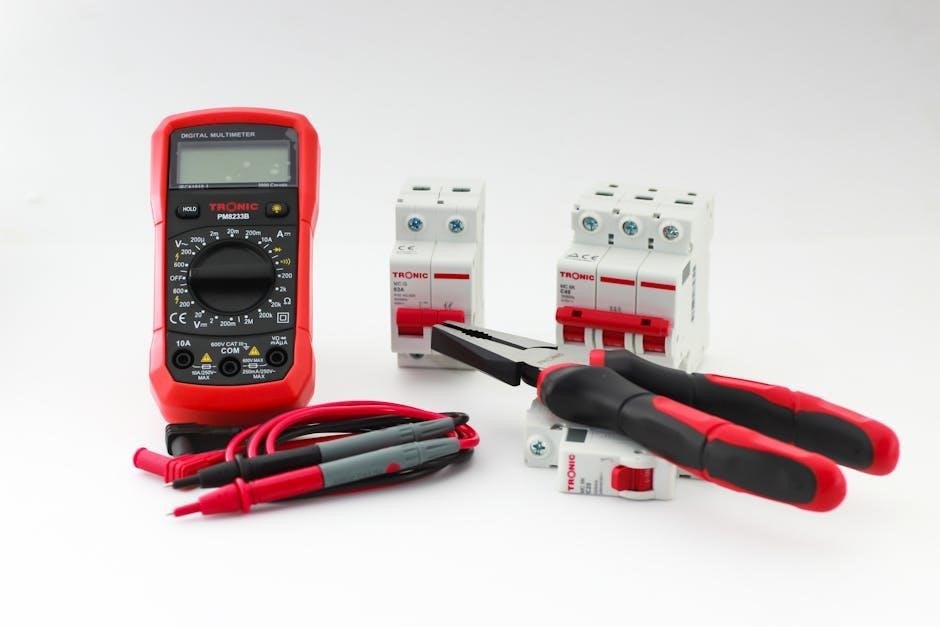
Commercial Electric multimeters, like the DMM-8301S and MS8301A, are essential tools for electrical work. These TRUE RMS, auto-ranging devices offer versatile and accurate measurements.
Understanding the user manual is crucial for safe and effective operation, ensuring reliable results for both novice and experienced users.
What is a Multimeter?
A multimeter is a fundamental electrical testing tool, capable of measuring multiple parameters. Primarily, it assesses voltage (AC and DC), resistance, and continuity. More advanced models, like those from Commercial Electric, incorporate features such as capacitance measurement and diode testing.
These devices are indispensable for electrical troubleshooting, circuit analysis, and verifying the functionality of components. The Commercial Electric multimeter, detailed in its user manual, provides a safe and reliable way to diagnose electrical issues, ensuring accurate readings and preventing potential hazards.
Commercial Electric Multimeter Models (DMM-8301S, MS8301A)
Commercial Electric offers several multimeter models, notably the DMM-8301S and MS8301A. Both are TRUE RMS, auto-ranging digital multimeters designed for a wide range of electrical applications. The DMM-8301S is referenced in available user manuals online, detailing its features and operation.
These models share core functionalities but may differ in specific features or included accessories. Consulting the specific user manual for your model – DMM-8301S or MS8301A – is crucial for understanding its capabilities and ensuring safe, accurate measurements.

Safety Precautions
Electrical work carries inherent risks; always prioritize safety! Carefully review the Commercial Electric multimeter user manual for crucial warnings and safeguards before operation.
Following these guidelines minimizes the risk of electric shock or damage to the meter.
General Electrical Safety Rules
Always disconnect power sources before working on any electrical circuit. Never work alone, and ensure a clear, dry workspace. Utilize appropriate personal protective equipment (PPE), including insulated gloves and safety glasses.
Inspect test leads for damage before each use, replacing any compromised cables immediately. Avoid touching exposed conductors or components. Be aware of your surroundings and potential hazards. Understand the limitations of the meter and never exceed its specified ratings. Prioritize safety by adhering to all local electrical codes and regulations.
Specific Warnings for Commercial Electric Multimeters
Never operate the meter with a damaged case or leads. Immediately replace the battery when the low battery indicator illuminates to prevent inaccurate readings and potential shock.
Avoid applying voltage exceeding the meter’s maximum input voltage. Do not use the meter in hazardous environments. Always follow the manual’s instructions for proper function selection; Improper use can lead to electric shock or damage to the meter. Ensure the meter is used within its specified safety category.
Understanding Safety Symbols
The manual utilizes specific symbols to highlight potential hazards. A lightning bolt within a triangle signifies a risk of electric shock; exercise extreme caution. The exclamation point within a triangle indicates important safety instructions – heed these warnings!
Double insulation symbols denote enhanced protection. Pay attention to symbols regarding fuse replacement and proper terminal connections. Ignoring these symbols can compromise safety and damage the meter. Familiarize yourself with each symbol before operation for safe and accurate measurements.

Multimeter Components & Features
Commercial Electric multimeters boast a clear display, a functional rotary switch, and input terminals. These features enable diverse electrical measurements with precision and ease of use.
The manual details each component’s purpose for optimal operation.
Front Panel Overview
The front panel of the Commercial Electric multimeter houses essential controls and input jacks. Key elements include the rotary switch for function selection – DC/AC Voltage, Resistance, Continuity, and more – and the input terminals accepting test leads.
The user manual clearly illustrates each component’s location and function. Understanding the panel layout is vital for accurate measurements. It also details the display area, which presents readings, and any dedicated buttons for specific features. Proper identification ensures safe and effective operation of the device.
Display Explanation
The multimeter’s display is a digital LCD screen presenting measurement values and status indicators. Commercial Electric’s user manual details each symbol’s meaning. Expect to see numerical readings, unit symbols (V, Ω, A), and annunciators for functions like auto-ranging or low battery.
Understanding these indicators is crucial for interpreting results correctly. The display also features a polarity indicator, showing positive or negative DC voltage. Familiarizing yourself with the display layout, as outlined in the manual, ensures accurate and safe operation.
Rotary Switch Functions
The rotary switch selects the desired measurement function and range. Commercial Electric’s multimeter user manual meticulously explains each position. Settings include DC Voltage (VDC), AC Voltage (VAC), Resistance (Ω), Continuity, and Diode test.
Proper selection is vital for accurate readings and preventing damage to the meter. The manual emphasizes carefully aligning the switch with the intended function before applying test leads. Incorrect settings can lead to inaccurate results or potential hazards.

Basic Measurements
Commercial Electric’s multimeter user manual details fundamental measurements: DC/AC Voltage and Resistance. These functions are essential for basic electrical circuit testing and troubleshooting.
Follow the manual’s guidance for proper lead connections and range selection.
Measuring DC Voltage
According to the Commercial Electric multimeter user manual, to measure DC Voltage, select the “V=” function on the rotary switch. Insert the black test lead into the “COM” jack and the red lead into the “V” jack. Connect the probes in parallel with the circuit or component you wish to measure.
The display will show the DC voltage reading. If the polarity is reversed, a negative sign will appear. Always refer to the manual for specific voltage ranges and safety precautions when working with DC circuits, ensuring accurate and safe measurements.
Measuring AC Voltage
The Commercial Electric multimeter user manual details AC Voltage measurement as follows: turn the rotary switch to the “V~” position. Ensure the black test lead is connected to the “COM” jack and the red lead to the “V” jack. Connect the probes in parallel with the AC circuit or component under test.
The display will indicate the AC voltage. Always consult the manual for appropriate voltage ranges and safety guidelines. Incorrect settings or procedures can lead to inaccurate readings or potential hazards when measuring AC voltage.
Measuring Resistance
The Commercial Electric multimeter user manual instructs to turn the rotary switch to the “Ω” position for resistance measurements. Connect the black test lead to the “COM” jack and the red lead to the “V/Ω” jack. Ensure the power to the circuit being tested is completely OFF.
Connect the probes across the resistor or component. The display will show the resistance value. Always start with the highest range and decrease for better accuracy, referencing the manual for proper usage.

Advanced Measurements
The Commercial Electric multimeter user manual details advanced tests like continuity, diode testing, and capacitance measurement, expanding its utility beyond basic voltage and resistance checks.
These features provide deeper insights into circuit functionality and component health.
Continuity Testing
The Commercial Electric multimeter user manual explains continuity testing verifies a complete electrical path. Select the continuity function, often symbolized by a diode or sound wave.
Touch the probes to the circuit points you wish to test. A low resistance (typically below 30 ohms) will trigger an audible beep, indicating continuity.
This is useful for checking wires, fuses, and switch connections. Ensure the circuit is de-energized before testing to avoid damage to the meter or personal injury. A lack of a beep signifies a break in the circuit.
Diode Testing
The Commercial Electric multimeter user manual details diode testing to check the functionality of diodes. Select the diode test function, usually marked with a diode symbol. Connect the red probe to the anode (positive side) and the black probe to the cathode (negative side) of the diode.
A good diode will show a forward voltage drop, typically between 0.5V and 0.8V. Reversing the probes should display “OL” or a very high resistance, indicating an open circuit.
A reading of 0V in both directions suggests a shorted diode.
Capacitance Measurement
The Commercial Electric multimeter user manual explains capacitance measurement for checking capacitor values. Turn the rotary switch to the capacitance (F) setting. Discharge the capacitor before testing to avoid damage to the meter or inaccurate readings. Connect the probes to the capacitor leads, polarity doesn’t matter.
The display will show the capacitance value in Farads (F), microfarads (µF), or picofarads (pF). Note that larger capacitors may take longer to stabilize a reading.
Compare the measured value to the capacitor’s marked value.
Using the Multimeter
The Commercial Electric multimeter user manual stresses proper battery installation and replacement. A low battery indicator warns of diminished power, potentially causing inaccurate readings.
Utilize the auto-ranging feature for simplified measurements.
Battery Installation & Replacement
Commercial Electric multimeter operation relies on a functioning battery. To install, open the battery compartment—typically on the rear of the device—and insert the correct type (usually AAA).
Ensure proper polarity, matching the positive (+) and negative (-) terminals as indicated inside the compartment. A secure fit is essential for accurate readings.
The user manual emphasizes immediate battery replacement when the low battery indicator appears, as a weak battery can introduce errors and compromise measurement reliability.
Always dispose of used batteries responsibly.
Low Battery Indicator
The Commercial Electric multimeter features a low battery indicator to alert users when power is diminishing. This symbol, often a battery icon, appears on the display when the battery voltage drops below a critical level.
The user manual explicitly warns against continuing use when this indicator is active, as a low battery can cause inaccurate readings and potentially lead to incorrect diagnoses or unsafe conditions.
Immediate battery replacement is crucial to maintain measurement precision and ensure the reliable operation of the meter. Ignoring this warning can compromise the integrity of your work.
Auto-Ranging Feature
The Commercial Electric multimeter boasts an auto-ranging function, simplifying measurements by automatically selecting the appropriate range for the input signal. This eliminates the need for manual range selection, reducing the risk of overload or inaccurate readings.
As detailed in the user manual, this feature enhances usability, particularly for users unfamiliar with specific voltage or resistance levels. The meter intelligently adjusts, providing a stable and precise display value.
Auto-ranging contributes to efficient troubleshooting and ensures accurate results across a wide spectrum of electrical applications.
Troubleshooting
Commercial Electric multimeter issues can often be resolved by checking the user manual for common problems, error codes, and solutions like fuse replacement.
Addressing low battery warnings promptly prevents inaccurate readings.
Common Issues & Solutions
If the multimeter displays no reading, first verify the battery installation and ensure it isn’t low. A depleted battery causes inaccurate results or a blank screen. For incorrect readings, confirm proper function selection on the rotary switch and check for blown fuses.
If continuity testing fails, ensure the test leads are securely connected and the circuit is powered off. Regarding diode testing inaccuracies, double-check the polarity of the leads. Always consult the user manual for detailed troubleshooting steps and safety precautions before attempting any repairs.
Error Codes & Their Meanings
The Commercial Electric multimeter’s display may show error codes indicating specific problems. While the user manual doesn’t extensively detail codes, a common issue is “OL” or “1.” This signifies an overload – the measured value exceeds the multimeter’s range;
A low battery can also cause erratic readings or error indications. If encountering unexplained errors, replace the battery and re-test. Refer to the manual for fuse replacement instructions if a blown fuse is suspected, as this can also trigger display errors.
Fuse Replacement
The Commercial Electric multimeter utilizes fuses to protect its internal circuitry. If the meter displays no reading or an error after checking the battery, a blown fuse is likely. Consult the user manual for the specific fuse type and location – typically on the rear panel.
Always disconnect test leads before opening the fuse compartment. Replace only with a fuse of the exact rating; using a higher value risks damaging the meter. Ensure the replacement is securely seated before reassembling.
Technical Specifications
The Commercial Electric multimeter boasts detailed specifications, including accuracy ratings, input impedance, and maximum input voltage. Refer to the user manual for precise values.
These parameters define the meter’s performance and limitations for various measurements.
Accuracy Specifications
The Commercial Electric multimeter’s accuracy is a critical factor in obtaining reliable measurements. The user manual details these specifications, typically expressed as a percentage of reading plus a number of digits.
Accuracy varies depending on the measurement function (DC Voltage, AC Voltage, Resistance, etc.) and the measurement range selected. Understanding these specifications is vital for interpreting results correctly and assessing the meter’s suitability for specific applications. Always consult the manual for detailed accuracy information.
Input Impedance
The Commercial Electric multimeter’s input impedance is a crucial specification, particularly when measuring voltage. The user manual will state this value, typically expressed in megaohms (MΩ). Higher input impedance minimizes circuit loading, ensuring more accurate voltage readings.
Lower impedance can draw current from the circuit under test, altering its behavior and affecting the measurement. Understanding input impedance helps users avoid inaccurate readings and maintain the integrity of the tested circuit. Refer to the manual for specific values.
Maximum Input Voltage
The Commercial Electric multimeter’s user manual clearly defines the maximum input voltage for each measurement range. Exceeding this limit can damage the meter and pose a safety hazard. The manual specifies separate maximums for AC and DC voltage measurements.
Always verify the voltage being measured does not surpass the multimeter’s specified limit. Ignoring this precaution can lead to blown fuses, inaccurate readings, or even permanent instrument failure. Prioritize safety and consult the manual before each measurement.
Maintenance & Care
The user manual advises regular cleaning and proper storage to maintain accuracy. Avoid harsh chemicals; a damp cloth is sufficient. Calibration information is also provided.
Following these guidelines ensures long-term reliability and optimal performance of your Commercial Electric multimeter.
Cleaning the Multimeter
Regular cleaning is vital for maintaining the accuracy and longevity of your Commercial Electric multimeter. Always disconnect test leads and ensure the meter is powered off before cleaning.
The user manual recommends wiping the exterior with a damp cloth, avoiding abrasive cleaners or solvents. Do not immerse the meter in liquid. For stubborn dirt, a mild soap solution can be used, but ensure it’s thoroughly rinsed and the meter is completely dry before use.
Pay particular attention to the display and the rotary switch, removing any dust or debris that may accumulate. Proper cleaning contributes to reliable performance.
Storage Guidelines
Proper storage extends the life of your Commercial Electric multimeter. The user manual advises storing the meter in a dry, dust-free environment, away from extreme temperatures and humidity.
Avoid storing with or near metallic objects that could cause short circuits. It’s best to keep the multimeter in its original case or a similar protective container. Remove the batteries if the meter will be stored for an extended period to prevent corrosion and potential damage.
Ensure the rotary switch is in the ‘OFF’ position during storage.
Calibration Information
The Commercial Electric multimeter’s user manual doesn’t detail user-performed calibration procedures. Maintaining accuracy relies on periodic professional calibration. Calibration ensures measurements align with traceable standards, vital for reliable electrical testing.
Frequency depends on usage and required accuracy; annual calibration is generally recommended for professional applications. Contact a qualified calibration laboratory for service. Attempting self-calibration without proper equipment and expertise can compromise the meter’s accuracy and void any warranty.
Regular checks against known standards are advised.

Understanding True RMS
Commercial Electric multimeters feature True RMS, providing accurate AC voltage and current readings for non-sinusoidal waveforms. This ensures precise measurements for complex electrical circuits.
What is True RMS and Why Does it Matter?
True RMS (Root Mean Square) is a method of measuring AC voltage and current that accurately reflects the heating value of the waveform, regardless of its shape. Standard multimeters often assume a pure sine wave, leading to inaccurate readings with distorted signals.
However, modern electrical devices often generate non-sinusoidal waveforms. Therefore, a Commercial Electric multimeter with True RMS capability delivers precise measurements for these complex signals, crucial for reliable troubleshooting and accurate analysis of electrical systems. It matters because it provides a correct representation of power.
Commercial Electric Multimeter RMS Capabilities
The Commercial Electric DMM-8301S is specifically advertised as a TRUE RMS multimeter, meaning it accurately measures AC voltage and current even with distorted waveforms. This is a significant advantage over standard multimeters that assume a pure sine wave.
This capability ensures precise readings when working with modern electrical devices that produce non-sinusoidal signals. The manual emphasizes the importance of True RMS for reliable measurements, particularly when diagnosing complex electrical issues, providing confidence in your results.
Compliance & Standards
Commercial Electric multimeters adhere to the IEC-61010 safety standard, ensuring user protection. They also meet Electromagnetic Compatibility (EMC) requirements for reliable performance.
IEC-61010 Safety Standard
Commercial Electric multimeters are designed with adherence to the IEC-61010 international safety standard, a critical aspect of their construction and operation. This standard defines specific safety requirements for electrical measuring instruments, protecting users from potential hazards like electric shock and fire.
The IEC-61010 compliance ensures the multimeter has undergone rigorous testing to meet stringent safety criteria. This includes insulation strength, creepage and clearance distances, and overall mechanical integrity. Always refer to the user manual for detailed safety instructions and warnings to maximize protection while using the device.
Electromagnetic Compatibility (EMC)
Commercial Electric multimeters are designed to minimize interference with other electronic devices and to resist interference from external sources – a principle known as Electromagnetic Compatibility (EMC). This ensures accurate readings and reliable performance in various electrical environments.
The user manual may contain information regarding potential sources of interference and recommended practices to mitigate their effects. While these multimeters are built to withstand typical EMC conditions, extremely high electromagnetic fields could potentially impact accuracy. Proper usage, as outlined in the manual, is key.
Leave a Reply
You must be logged in to post a comment.